How to use this Bazi calculator
- Enter your date of birth as it appears on your birth certificate, in the ordinary Gregorian calendar. Do not convert it to the Chinese lunar calendar first. The calculator works out the solar terms itself.
- Enter your birth time and the city where you were born. The city gives the time zone used on that date and the longitude for true solar time. If your city is not listed, choose “Other place” and enter the UTC offset and longitude.
- Choose a gender and press Calculate. Gender is only used to decide whether your Luck Pillars run forward or backward, as in the classical method.
Tips for an accurate Bazi chart
- Use a recorded time. Hospital records and birth certificates are better than family memory, which is often rounded to the hour.
- Pick your birthplace, not where you live now. Longitude decides true solar time, and true solar time decides the hour pillar.
- Don't adjust for old time zones or daylight saving yourself. The Bazi calculator already knows, for example, that Singapore and Peninsular Malaysia used UTC+7:30 until 31 December 1981 and that China used daylight saving time from 1986 to 1991.
- Read the notes under your chart. If you were born close to a solar term or near 23:00, the notes tell you which pillar would change if your time were a little off.
What your Bazi chart shows
A Bazi chart has eight characters arranged in four columns. Read in the traditional order, from right to left, they are the year, month, day and hour of birth. The Bazi calculator above shows them left to right as hour, day, month and year, which is how most Chinese almanacs print them. Below each column you will find the hidden stems, the Ten Gods and the Na Yin element.
The Four Pillars
- Year pillar: ancestry, family background and early childhood. Its branch gives your animal in the Bazi system.
- Month pillar: parents, upbringing and the season you were born in. Because the season decides which elements are strong, many practitioners treat the month as the most important pillar after the day.
- Day pillar: you. The day stem is your Day Master, and the day branch is often called the spouse palace.
- Hour pillar: children, later life and your inner plans. It is the pillar most often wrong, because it depends on an exact birth time.
Day Master (日主)
Since the Song dynasty, the Ziping method, named after Xu Ziping, has placed the day stem at the centre of the chart. Every other character is read by how it relates to this Day Master. There are ten possible Day Masters, one for each Heavenly Stem, from 甲 Jia (Yang Wood, a tall tree) to 癸 Gui (Yin Water, rain and mist). The table further down describes all ten.
Five Elements (五行)
Every stem and branch belongs to one of the Five Elements: Wood, Fire, Earth, Metal and Water. Wood feeds Fire, Fire makes Earth, Earth bears Metal, Metal carries Water and Water nourishes Wood. In the controlling cycle, Wood breaks Earth, Earth dams Water, Water puts out Fire, Fire melts Metal and Metal cuts Wood. The Bazi calculator counts the elements among your visible stems and branches and lists any element that is missing. A missing element is common and is not bad in itself. What matters is how the elements serve your Day Master.
Ten Gods (十神)
The Ten Gods name the relationship between each character and your Day Master, based on element and yin–yang polarity:
- Friend (比肩) and Rob Wealth (劫财): the same element as you; peers, siblings, competition.
- Eating God (食神) and Hurting Officer (伤官): the element you produce; talent, expression, output.
- Indirect Wealth (偏财) and Direct Wealth (正财): the element you control; money, resources, effort.
- Seven Killings (七杀) and Direct Officer (正官): the element that controls you; authority, discipline, pressure.
- Indirect Resource (偏印) and Direct Resource (正印): the element that produces you; learning, support, protection.
Hidden stems (藏干)
Each Earthly Branch holds one to three Heavenly Stems inside it. 子 Zi holds only 癸 Gui Water, while 丑 Chou holds 己 Ji Earth, 癸 Gui Water and 辛 Xin Metal. Hidden stems are why a chart that looks short of an element may still contain it. The Bazi calculator lists every hidden stem with its Ten God.
Luck Pillars (大运)
Luck Pillars are ten-year periods that follow the month pillar forward or backward through the cycle of sixty. They run forward for a man born in a yang year or a woman born in a yin year, and backward otherwise. The starting age comes from the time between your birth and the nearest solar term in the direction of travel. Each three days of that gap count as one year of age. The Bazi calculator works this out from the exact moment of the solar term, so your starting age is given to the month.
Na Yin (纳音)
The sixty stem–branch pairs are grouped into thirty Na Yin, or “sound” elements, such as 海中金 Gold in the Sea or 天上火 Fire in the Sky. Na Yin is an older layer of Chinese astrology that is still used for compatibility and for describing a year's character.
Why Bazi calculators give different results
Enter the same birthday into five free Bazi calculators and you may get three different charts. The math is simple, but a few rules decide where each pillar begins, and calculators handle them differently. This Bazi calculator handles each one explicitly and tells you when it affects your chart.
1. The Bazi year starts at Li Chun, not Chinese New Year
The year pillar changes at Li Chun (立春, Start of Spring), the moment the sun reaches 315° of ecliptic longitude. That falls on 3, 4 or 5 February. Chinese New Year follows the moon and moves between 21 January and 20 February. In 1990, Chinese New Year fell on 27 January, but Li Chun only arrived at 10:14 on 4 February. A baby born in Singapore at 08:00 that morning belongs to the 己巳 Snake year in Bazi, even though most zodiac charts would call them a Horse.
2. Months follow the solar terms, to the minute
A Bazi month is not a lunar month. It begins at one of twelve solar terms (节, jie), such as 惊蛰 Awakening of Insects or 白露 White Dew. These are fixed points of the sun's path, and they arrive at a precise minute that differs from year to year. This Bazi calculator computes the sun's apparent longitude with the VSOP87 planetary theory, following Jean Meeus's Astronomical Algorithms. Its solar term times match published almanac times to within about a minute.
3. True solar time vs clock time
The hour pillar was designed for sundial time, while clocks follow time zones. Singapore sits at 103.8° E but uses UTC+8, a zone centred on 120° E, so its clocks run about an hour ahead of the sun. On 4 February 1990, 08:00 on a Singapore clock was 06:41 by the sun. After the equation of time is applied, that gives the hour pillar 己卯 (Rabbit) instead of 庚辰 (Dragon). Most traditional practitioners use true solar time, but not all calculators do. Whenever the two methods give different pillars, this Bazi calculator shows both.
4. The Rat hour (23:00–00:59)
The first double-hour of the day, 子 Zi, runs from 23:00 to 00:59. The traditional rule starts the new day at 23:00. Another school keeps the calendar day until midnight and calls 23:00–23:59 the “late Rat hour”. The calculator uses the traditional rule by default and lets you switch in Advanced options.
5. Historical time zones and daylight saving
Clocks have not always kept the time they keep today. Singapore and Peninsular Malaysia used UTC+7:30 until 31 December 1981, while Sabah and Sarawak were on UTC+8. China used daylight saving time from 1986 to 1991, and Hong Kong and Taiwan observed summer time in many years up to 1979. The calculator looks up the offset that applied on your birth date in the IANA time zone database, so you never need to correct it by hand.
Boundary cases you can test
| Birth (local clock time) | What happens | Result in this Bazi calculator |
|---|---|---|
| 4 Feb 1990, 08:00, Singapore | Li Chun arrives at 10:14 that morning; clocks run ahead of the sun | Year 己巳 (Snake), month 丁丑; hour 己卯 by true solar time (06:41), 庚辰 by clock time |
| 4 Feb 1984, 23:30, Hong Kong | Born 11 minutes after Li Chun (23:19) | Year 甲子 (Rat), month 丙寅; by true solar time it is still 22:52, so the day is 戊辰 and the hour 癸亥 |
| 1 Jan 2000, 00:30, Beijing | New Year's Day, but before both Chinese New Year and Li Chun | Year 己卯 (Rabbit), month 丙子, day 戊午, hour 壬子 |
| 1 Jun 1988, 11:30, Beijing | China was on daylight saving time (UTC+9) | True solar time 10:17, so the hour is 乙巳 (Snake), not 丙午 (Horse) |
Heavenly Stems and Earthly Branches in a Bazi chart
Every pillar of a Bazi chart pairs one of ten Heavenly Stems with one of twelve Earthly Branches. The pairs repeat in a cycle of sixty, which is why years, months, days and hours all share the same names. The Bazi calculator uses the two tables below for every chart it draws.
The ten Heavenly Stems (天干) and Day Masters
| Stem | Pinyin | Element | Image | As a Day Master |
|---|---|---|---|---|
| 甲 | Jia | Yang Wood | Tall tree | Upright, principled, grows steadily, likes to lead |
| 乙 | Yi | Yin Wood | Flowers, vines | Flexible, diplomatic, finds a way around obstacles |
| 丙 | Bing | Yang Fire | The sun | Warm, generous, expressive, hard to ignore |
| 丁 | Ding | Yin Fire | Candle, lamp | Perceptive, attentive, a steady inner light |
| 戊 | Wu | Yang Earth | Mountain | Stable, reliable, protective, slow to change |
| 己 | Ji | Yin Earth | Farmland | Nurturing, practical, accommodating |
| 庚 | Geng | Yang Metal | Axe, raw ore | Decisive, direct, loyal, strong-willed |
| 辛 | Xin | Yin Metal | Jewellery | Refined, sensitive, values quality and detail |
| 壬 | Ren | Yang Water | Ocean, great river | Resourceful, broad-minded, always moving |
| 癸 | Gui | Yin Water | Rain, mist | Intuitive, quiet, imaginative |
The twelve Earthly Branches (地支)
| Branch | Animal | Element | Hours | Bazi month begins at | Hidden stems |
|---|---|---|---|---|---|
| 子 Zi | Rat | Water | 23:00–00:59 | 大雪 Major Snow, ~7 Dec | 癸 |
| 丑 Chou | Ox | Earth | 01:00–02:59 | 小寒 Minor Cold, ~6 Jan | 己 癸 辛 |
| 寅 Yin | Tiger | Wood | 03:00–04:59 | 立春 Li Chun, ~4 Feb | 甲 丙 戊 |
| 卯 Mao | Rabbit | Wood | 05:00–06:59 | 惊蛰 Awakening of Insects, ~6 Mar | 乙 |
| 辰 Chen | Dragon | Earth | 07:00–08:59 | 清明 Clear and Bright, ~5 Apr | 戊 乙 癸 |
| 巳 Si | Snake | Fire | 09:00–10:59 | 立夏 Start of Summer, ~6 May | 丙 戊 庚 |
| 午 Wu | Horse | Fire | 11:00–12:59 | 芒种 Grain in Ear, ~6 Jun | 丁 己 |
| 未 Wei | Goat | Earth | 13:00–14:59 | 小暑 Minor Heat, ~7 Jul | 己 丁 乙 |
| 申 Shen | Monkey | Metal | 15:00–16:59 | 立秋 Start of Autumn, ~8 Aug | 庚 壬 戊 |
| 酉 You | Rooster | Metal | 17:00–18:59 | 白露 White Dew, ~8 Sep | 辛 |
| 戌 Xu | Dog | Earth | 19:00–20:59 | 寒露 Cold Dew, ~8 Oct | 戊 辛 丁 |
| 亥 Hai | Pig | Water | 21:00–22:59 | 立冬 Start of Winter, ~7 Nov | 壬 甲 |
Bazi chart example: 4 February 1990, 08:00, Singapore
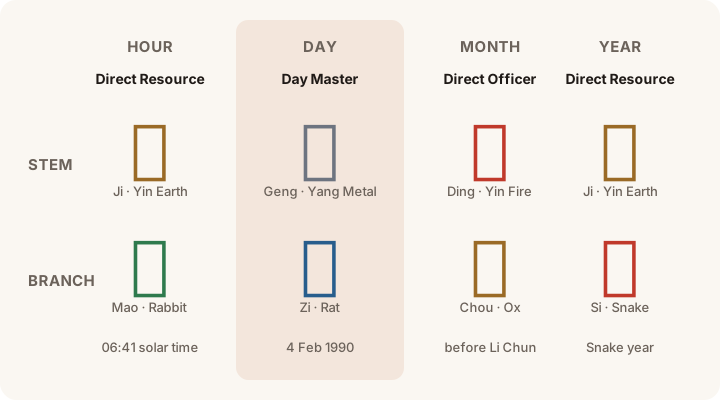
This is the chart the Bazi calculator produces for that birth. The Day Master is 庚 Geng, Yang Metal, born in the 丑 Ox month in the depth of winter, two hours before Li Chun.
- Pillars: year 己巳, month 丁丑, day 庚子, hour 己卯 (true solar time 06:41).
- Five Elements: Earth 3, Fire 2, Metal 1, Water 1, Wood 1. Earth is the element that produces Metal, so the Day Master has plenty of support.
- Ten Gods: the two 己 stems are Direct Resource (正印) and 丁 is Direct Officer (正官). The day branch 子 hides 癸, a Hurting Officer (伤官).
- Luck Pillars: a yin year and a male chart run backward from 丁丑. The gap back to Minor Cold (小寒, 5 January 1990, 22:33) is 29.4 days, so the first Luck Pillar, 丙子, starts at age 9 years 9 months, around 1999. It is followed by 乙亥 (2009), 甲戌 (2019) and 癸酉 (2029).
A calculator that starts the year at Chinese New Year would give this person the 庚午 Horse year and the 戊寅 month, which is a different chart altogether.
Bazi vs Chinese zodiac: what's the difference?
Your Chinese zodiac sign is just one character of your Bazi chart: the branch of the year pillar. Everyone born in the same zodiac year shares it. A full Bazi chart combines 60 possible years, 12 months, 60 days and 12 hours, which gives 518,400 possible charts. That is why two people born in the same Year of the Dragon can have very different charts. The zodiac sign describes your generation. The Bazi chart describes you.
The two systems also start the year at different moments. Bazi uses the solar term Li Chun, while popular zodiac tables use Chinese New Year. That is why this Bazi calculator labels its animal as the Bazi year animal. If you only need your animal sign, any zodiac table will do. If you want the whole chart, use the Bazi calculator at the top of this page.
What Is My Chinese Zodiac Sign?
Only need your animal? The Chinese zodiac calculator finds your sign, element and yin–yang from your date of birth alone. It checks the exact date of Chinese New Year from 1900 to 2100, so January and February birthdays come out right, and it tells you when your Bazi animal is different.
Chinese Zodiac 2027: Year of the Fire Sheep
2027 is a 丁未 Fire Sheep (Goat) year. Chinese New Year falls on Saturday 6 February 2027, but the Bazi year begins two days earlier, at Li Chun on 4 February at 09:46 Beijing time. The guide covers which signs clash with the Sheep, all twelve month pillars of 2027, and every Sheep year since 1907 with exact dates.
I Ching Reading: Free Online Coin Toss
Where a Bazi chart describes a whole life, the I Ching looks at one question at one moment. Hold a question in mind, toss three virtual coins six times, and read your hexagram, its changing lines and the hexagram it turns into. All 64 hexagrams are explained in plain English.
Bazi calculator FAQ
What is a Bazi calculator?
A Bazi calculator converts your birth date, time and place into the Four Pillars of Destiny: four pairs of Chinese characters for the year, month, day and hour of birth. Each pair is a Heavenly Stem and an Earthly Branch, so the chart has eight characters, which is what Bazi (八字) means.
Is this Bazi calculator free?
Yes. The full chart, including Ten Gods, hidden stems, Na Yin and ten Luck Pillars, is free and needs no account or email address.
What if I don't know my birth time?
Tick “I don't know my birth time”. You will get the year, month and day pillars, which make up six of the eight characters. The hour pillar is left empty, and Luck Pillar ages are estimated from 12:00 noon.
Should I use true solar time?
Traditional Bazi reads the hour from the position of the sun, so true solar time is switched on by default. In places whose clocks run far ahead of the sun, such as Singapore and Malaysia, it can change the hour pillar. When clock time and true solar time give different pillars, the calculator shows both.
Why is my Chinese zodiac animal different on other sites?
Bazi starts the year at Li Chun (立春), around 4 February. Most zodiac charts start it at Chinese New Year, which moves between 21 January and 20 February. If you were born between those two dates, the two methods can give different animals. For a Bazi chart, Li Chun is the rule.
I was born between 23:00 and 00:59. Which day is my day pillar?
That is the Rat hour. By default the calculator follows the traditional rule that a new day begins at 23:00, so a birth at 23:30 uses the next day's pillar. You can switch to the late Rat hour rule in Advanced options, which keeps the calendar day.
Is my birth data stored or sent anywhere?
No. The calculation runs entirely in your browser. Your birth details are not sent to a server, and they are only saved in the page address if you choose to copy a share link.
How accurate is this Bazi calculator?
Solar terms are computed from the sun's apparent longitude using the VSOP87 theory, and match published almanac times to within about a minute. Historical time zones and daylight saving come from the IANA time zone database. Accuracy is still limited by the birth time you enter.
Can Bazi predict the future?
Bazi is a traditional Chinese way of describing character and timing. It is not a science. Use your chart for self-reflection and cultural interest, not for medical, legal or financial decisions.
How this Bazi calculator works
The pillar rules follow the classical Ziping school, as set out in 《渊海子平》 Yuanhai Ziping (Song dynasty) and 《三命通会》 Sanming Tonghui (Ming dynasty). The astronomy follows Jean Meeus, Astronomical Algorithms (2nd edition): the VSOP87 theory of Bretagnon and Francou for the sun's position, with corrections for nutation and aberration and the Espenak–Meeus values for ΔT. Time zone history comes from the IANA database. To learn more about the tradition itself, see Four Pillars of Destiny on Wikipedia.
Enter your birthday, get your Four Pillars.
The Bazi calculator takes ten seconds, it is free, and nothing leaves your device.
Open the Bazi calculator